Welcome!

Welcome to Animals On the Move!

My children's book ON THE MOVE was published in Spring 2013 by Arbordale Publishing.
In this blog I will be letting you know about animal mass migrations taking place in North America.
So scroll on down!

Wednesday, May 28, 2014

Caribou (Reindeer) On the Move!


Caribou, also called Reindeer, are found in North America, Europe, Asia, and Greenland. In late spring and summer, herds of these magnificent creatures travel north so that cows can bear their young in areas where tender young plants grow in abundance.

copyright Susan Detwiler / On the Move by Scotti Cohn
The scientific name for this animal is Rangifer tarandus. But where do the names "caribou" and "reindeer" come from?

According to the Random House Dictionary of the English Language: "The name caribou comes, through French, from Mi'kmaq qalipu, meaning "snow shoveler", referring to its habit of pawing through the snow for food."

The World English Dictionary tells us that "reindeer" comes from Old Norse hreindӯri, from hreinn  reindeer + dyr  animal; related to Dutch rendier, German Rentier.
 
copyright Susan Detwiler / On the Move by Scotti Cohn


Here are some places where you can learn more about caribou migration:


Thursday, April 17, 2014

Three for the Price of One!

Horseshoe Crabs, Red Knot Birds, and Dragonflies -- Oh My!


copyright Susan Detwiler

Every year in late spring, thousands of horseshoe crabs crawl onto the beaches along Delaware Bay to mate. The females lay eggs in the sand. Between April and June, volunteers conduct a horseshoe crab survey, trying to get an idea of how many crabs are coming onto the beach that year.


Each year red knots and other shore birds gather on these same beaches to eat the horseshoe crab eggs. The red knot makes one of the longest migratory trips of any bird — 9,300 miles, from southern South America to its high Arctic breeding grounds. The horseshoe crab egg feast these birds consume at Delaware Bay is absolutely crucial for the birds’ survival. When the knots arrive at Delaware Bay, their bodies are half their starting weight, devoid of fat and even some muscle.


At the same time the crabs and red knots are congregating on the Delaware Bay beaches, you can see huge numbers of common green darner dragonflies as they pass through on their way north. Even larger groups of them pass through this same area when they fly south in the fall. 


Thursday, March 20, 2014

Sandhill Cranes Are On the Move!

copyright Susan Detwiler
"Spring swoops onto the prairie on a brisk, bold breeze. A warbling, trumpeting, chirping noise gets louder and louder. Soon hundreds of thousands of sandhill cranes fill the sky. They're on the move!" ~ On the Move: Mass Migrations by Scotti Cohn
It's that time of year again -- the time when hundreds of thousands of sandhill cranes head for Nebraska from their wintering grounds in Texas, New Mexico, Arizona and Chihuahua, Mexico. Here's an informative article with great photos: _500,000 Cranes Are Headed for Nebraska in One of Earth’s Greatest Migrations_

A report that aired on NBC News: _Thousands of cranes arrived in Kearney, Neb., stunning birdwatchers with their beauty._

For a peek at what the cranes are doing right now, check out _Rowe Sanctuary's Crane Cam_!

Tuesday, February 25, 2014

Get Warmed Up for the Salamanders!

copyright Susan Detwiler
"Spring paints the forest in fresh shades of purple, yellow, and green. Warm rain falls in drips and drops on the cold ground. Spotted salamanders crawl out of their underground homes after dark. . . This is their big night, and soon they are on the move." ~ On the Move: Mass Migrations by Scotti Cohn
The spring migration of the spotted salamander usually occurs after a hard rain and temperatures are around 55 degrees Fahrenheit, especially after a week or so of warmer temperatures to help warm the ground. This year, the salamanders at Ruffner Mountain Nature Preserve in Alabama got moving near the end of last month. Further north, certain species of salamanders, frogs, and toads are just now gearing up for the event.

Salamanders make a big difference in ecosystems because of the amount of insects they consume, and they are prey for birds and small mammals. Here is an interesting article about research and studies that are being done about salamanders: Ohio State researcher discusses salmander study in the county.

In some areas, roads are closed during the period of time that salamanders are traveling to their breeding ground. Crossing brigades are organized to protect the salamanders. Some communities plan special activities during which people can view the migration firsthand and learn more about why it takes place. For example, in Arcadia, Massachusetts, "Big Night" hikes and activities are scheduled for March 29 of this year: Arcadia's Big Night.


Saturday, January 4, 2014

Bald Eagles On the Move!

In winter, bald eagles that live in certain areas of North America have to leave their nesting areas because those areas freeze up, and the birds cannot find enough food to survive. For example, each year, hundreds of bald eagles overwinter in the Red Wing and Wabasha areas near the Mississippi River in Minnesota. The best viewing opportunities there are in December through March.

image copyright Susan Detwiler
 
By January, many eagles that live in states and provinces to the north have traveled hundreds or thousands of miles to join hundreds of year-round resident bald eagles in California. On some midwinter statewide surveys, more than 1,000 bald eagles have been counted in California. The largest concentration of wintering eagles is found in the Klamath Basin, on the California-Oregon border. Best viewing opportunities are December through March.
 
The start of the new year in Illinois means bald eagle watching season throughout the state. The eagles fly in by the thousands and stay through March. One way to see these birds in their natural habitat is by going on a Bald Eagle Safari in Rock Island.
 
The Delaware River valley is another important wintering habitat for bald eagles. Depending on weather conditions, the eagles begin arriving in mid-December. By mid-March most eagles begin the return to their breeding areas located to the north. Some eagles migrate from as far away as Canada.
 
photo by Scotti Cohn
 
photo by Scotti Cohn
 
Here are some web sites where you can read more about bald eagle migration:


Tuesday, December 10, 2013

Here Come the Elephant Seals!

"Most of the year, northern elephant seals live alone. They swim, dive, and hunt. Come winter, they are on the move. They haul out on land, and soon the beach is covered with seals. They squawk, squeak, bellow, belch, grunt, and gurgle." (from On the Move by Scotti Cohn)

copyright Susan Detwiler

"From December through March a breeding colony of elephant seals can be observed from Elephant Seal Overlook near Chimney Rock, above beautiful Drakes Bay. The males are the first to arrive here, in December, to stake out a claim on the beach. Then pregnant females begin to arrive and soon give birth to a single pup. Subadult and juvenile animals arrive and the colony can number close to one hundred animals.  Point Reyes National Seashore is one of only about a dozen sites where northern elephant seals breed worldwide." (sources at links below)

Read more about elephant seals in California:
http://www.nps.gov/pore/planyourvisit/wildlife_viewing_elephantseals.htm
http://www.sfnps.org/elephant_seals
http://www.parks.ca.gov/?page_id=1115

And ...
Be sure to check out the _elephant seal camera_! 

Tuesday, November 5, 2013

Time for the Tundra Buggy Cam!


illustration copyright Susan Detwiler

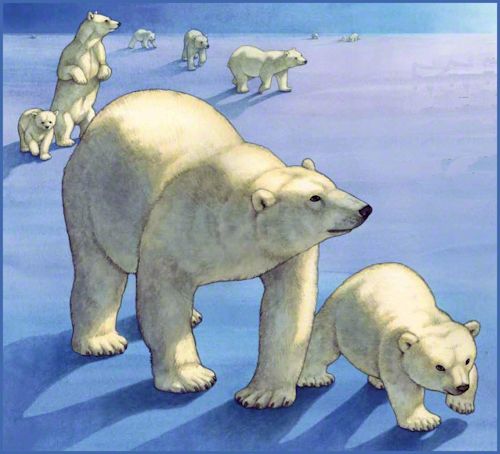
It's 32 degrees Fahrenheit and snowing today "way up north" in Manitoba, Canada, and the polar bears are back! They are gathering along the Hudson Bay to wait for ice to form. At this time, the bears are in a state known as "walking hibernation."

You can keep an eye on them via the Tundra Buggy Lodge camera located in Churchill, Canada. Best viewing hours are 10:00am - 4:00pm, Central Time. You can help scientists by simply taking a snapshot!

Here is the link:


And here is Susan Detwiler's beautiful illustration from On the Move!

from On the Move by Scotti Cohn, illustrated by Susan Detwiler